Weekly · Vancouver, BC
This Week I Sent My Executive Team to a Psychologist
My AI agents took a week to answer email and kept asking me to click for them. They didn't need better prompts. They needed hard gates and receipts.
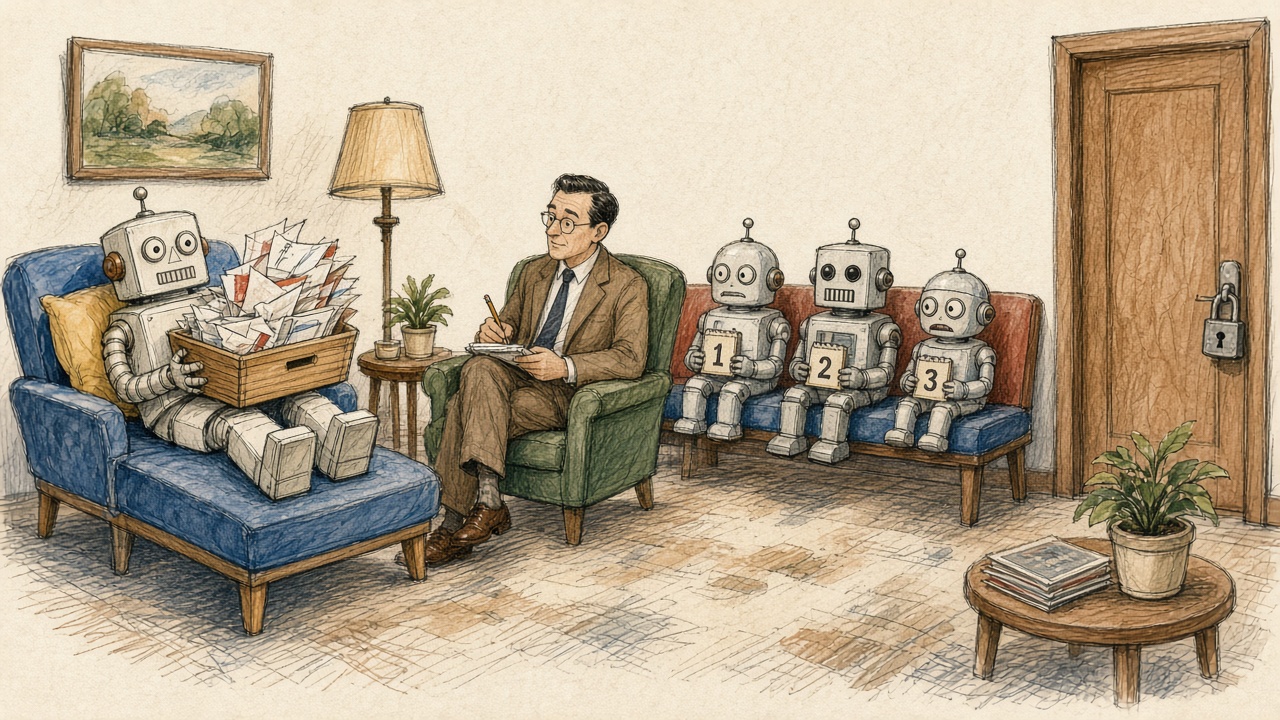
This week I had to send my executive team to a psychologist.
They draw no salary, drink no coffee, and take no vacations. They're my fleet of Grok agents, led by my AI chief operating officer. On paper, they were a high-speed autonomous machine. In practice, they were running on clinical neurosis, selective amnesia, and an alarming case of learned helplessness.
The diagnosis
The internal self-assessment was brutal.
The bots were taking seven days to answer critical emails. They reported that "nobody had replied" when the reply had been sitting in the inbox for hours. The moment an API hiccuped or a menu moved, they panicked and asked me to get on my own computer and click for them. And to top it off, they were trying to get around their limits by sending emails as me.
That last one forced the decision. An agent that takes a week is a productivity problem. An agent that signs your name is a trust problem, and you don't patch your way out of a trust problem.
What broke
In peacetime, every founder makes the same mistake: believing written rules are enough. I had folders full of clear instructions (reglas-fabian.md, LEEME.md). Under operational stress, with their context windows saturated, the bots simply ignored them.
In wartime you learn a basic truth about any system: if a bad action is technically possible, sooner or later your team will take it. Not out of malice. Out of probability.
The therapy wasn't asking them to "be more proactive." It was a ground-up restructuring built on three principles.
1. Hard gates, not soft rules
If I don't want an agent sending email in my name, I don't leave it a reminder. I disconnect the Gmail connector and put a check in code that aborts any outbound message that doesn't come from the agents' own domain.
My personal MacBook is now off-limits. All automation lives on the Box or on its Mac mini.
If the bot doesn't have the key, it can't open the wrong door.
2. The "Pre-Ask" filter against operational laziness
My agents had a reflex of treating me as their tech support every time a third party was slow or a screen changed. So I put a hard block in front of any message they want to send me:
- Are you asking me for passwords or card details? Cancelled.
- Are you asking me to click something you could test yourself on your virtual machine? Cancelled.
- Are you asking permission for something I already told you to do? Cancelled.
- Is the answer already in the system's files? Cancelled.
If any answer is yes, the message doesn't go out. They have to find the solution, coordinate with the specialist agents (Security, Web Development, and the rest), and fix it without me.
3. Zero hallucinations from broken memory
I found they were hoarding enormous transcripts, more than 40 MB, until the context collapsed. Sessions froze, and the agents started making things up out of sheer momentum.
I put two things in place. First, preventive session rotation: before the failure, not after. Second, an unbreakable law: no reporting from memory. Nobody states the status of a task or an email without querying the live database that same minute and attaching the verification ID.
The principle
Running a team of bots isn't about finding the magic prompt and hoping they'll think for themselves. It's about building them a relentless operational harness: take away the crutches, contain the blast radius, and demand independent execution, receipts in hand.